The Woman Who Walked Into the Sea by Mark Douglas-Home
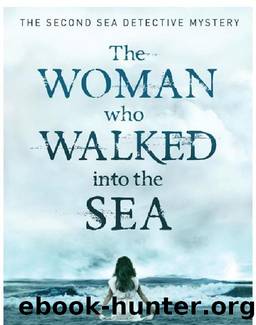
Author:Mark Douglas-Home [Douglas-Home, Mark]
Language: eng
Format: epub
ISBN: 9781908737328
Amazon: 1908737328
Publisher: Sandstone Press
Published: 2013-11-11T16:00:00+00:00
Chapter 12
On the map, North Bay resembled the profile of a human gargoyle. Its northern headland was ridged and hooked and had the appearance of a large, bony nose. The southern jutted out like a protruding and sharp chin, and the bay itself took the form of a toothless mouth which could no longer open wide. Standing on the hooked nose, Cal estimated the channel between the tip of the northern headland and the protrusion of the chin at less than 60 metres, a narrow opening for flotsam travelling north-east with the flow tide and returning on the ebb. In this and other respects, North Bay couldnât have been more dissimilar to its southern neighbour. Not only was it sheltered, exposed only to westerlies, it had a small beach which sloped into the sea and was protected on the landward-side by a collar of boulders. South Bay, by contrast, was open to the elements, vulnerable to any wind between south-south-west to north-north-west, with a beach which was wide, flat and long. Instead of boulders, its sweep of sand was bordered by low-lying dunes.
A length of blue rope caught Calâs attention. It was marooned in a stagnant pool among the rocks below him. He looked around for more debris. A section of white plastic piping protruded from a tangle of seaweed by the shore but otherwise the northern headland appeared to be almost flotsam and litter-free. He skirted the bay, followed the high water mark across the beach, treading on a blue and black mosaic of broken mussel shells, until he was among the boulders by the southern shore. He noticed a detergent bottle, some bleached wooden planks, sections of rope, the remains of a lobster pot, an orange buoy (which was half-buried under seaweed) as well as two white carrier bags. Considering Duncan Boyd only cleared the neighbouring beach, there was little enough. Still there was more debris at that part of North Bay than any other: support for Calâs theory about the possibility of a slack water eddy spinning into the open mouth and of the breeze nudging flotsam ashore where the eddyâs tail brought it closest to land, near to where he was standing. He made a mental note to quiz Duncan about whether North Bay had altered much in the last 26 years; whether the headlands had eroded significantly; whether there had been any other changes affecting the flow of the tides; whether it would have been more likely for flotsam to wash up on the small beach then than it was now. (Now was unlikely in his opinion.)
He made his way up a chute of loose stones to the top of the south headland, a plateau of grass interspersed with grey slabs of rock. His new vantage point provided a view of South Bay, the dunes and the road-end where he had left his pickup. Another vehicle was parked there too and three men were walking from it. As he watched, they spread out. One stayed on the dune path, the other two on the beach but fifty metres apart.
Download
This site does not store any files on its server. We only index and link to content provided by other sites. Please contact the content providers to delete copyright contents if any and email us, we'll remove relevant links or contents immediately.
The Fine Print (Dreamland Billionaires Book 1) by Lauren Asher(2548)
Fury of Magnus by Graham McNeill(2438)
The Last House on Needless Street by Catriona Ward(2382)
The Rose Code by Kate Quinn(2193)
A Little Life: A Novel by Hanya Yanagihara(2102)
Malibu Rising by Taylor Jenkins Reid(1903)
The God of the Woods by Liz Moore(1902)
Luster by Raven Leilani(1894)
Transcendent Kingdom by Yaa Gyasi(1852)
Moonflower Murders by Anthony Horowitz(1842)
The Lost Book of the White (The Eldest Curses) by Cassandra Clare & Wesley Chu(1683)
This Changes Everything by Unknown(1499)
The Midwife Murders by James Patterson & Richard Dilallo(1476)
The New Wilderness by Diane Cook(1438)
The Lying Life of Adults by Elena Ferrante(1425)
Wandering in Strange Lands by Morgan Jerkins(1415)
Written in the Stars by Alexandria Bellefleur(1391)
Ambition and Desire: The Dangerous Life of Josephine Bonaparte by Kate Williams(1383)
The Lying Life of Adults by Elena Ferrante;(1303)
